



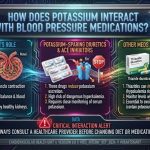





For tens of millions of adults managing hypertension—from corporate professionals in New York and San Francisco to residents across Texas, California, and Washington—blood pressure medications are a staple of daily health management. However, many patients are unaware that these life-saving cardiovascular drugs interact directly with potassium, an essential mineral and electrolyte responsible for regulating vascular tone and cellular cardiac activity.
Depending on the specific class of blood pressure medication prescribed, your body may either retain excess potassium—leading to a hazardous condition known as hyperkalemia—or waste potassium through urine, resulting in hypokalemia. Both extremes can trigger muscle weakness, severe fatigue, dangerous cardiac arrhythmias, and sudden medical emergencies.
This comprehensive clinical guide explains the physiological mechanisms connecting potassium to various antihypertensive drug classes, evaluates diagnostic tools and monitoring strategies, provides a comprehensive medication breakdown, and answers the top 10 frequently asked questions about managing potassium levels while taking blood pressure medications.
1. The Physiological Connection: The RAAS Axis and Renal Potassium Handling
To understand why blood pressure medications alter potassium levels, it is necessary to examine how the kidneys regulate fluid balance and blood pressure through the Renin-Angiotensin-Aldosterone System (RAAS).
How Aldosterone Controls Potassium Excretion
Under normal physiological conditions, when blood pressure or sodium levels drop, the kidneys release the enzyme renin. Renin converts angiotensinogen into angiotensin I, which is subsequently converted by Angiotensin-Converting Enzyme (ACE) into angiotensin II.
Angiotensin II stimulates the adrenal glands to secrete aldosterone, a steroid hormone that acts directly on the principal cells of the kidney’s distal convoluted tubule and collecting duct:
- Sodium Reabsorption: Aldosterone opens epithelial sodium channels ($ENaC$), pulling sodium and water back into the bloodstream to raise blood pressure.
- Potassium Excretion: To maintain electrical neutrality, aldosterone simultaneously triggers potassium excretion into the urine.
When blood pressure medications interfere with this pathway—by blocking renin release, inhibiting ACE enzymes, blocking angiotensin II receptors, or directly antagonizing aldosterone—aldosterone levels plummet. Without aldosterone signaling, the kidneys stop excreting potassium, causing serum potassium levels to rise rapidly in the bloodstream.
2. Comprehensive Drug Class Analysis: How Specific Medications Affect Potassium
Blood pressure medications do not all impact potassium in the same way. Antihypertensives fall into distinct categories based on whether they cause potassium retention, potassium wasting, or remain potassium neutral.
+-----------------------------------------------------------------------------------+
|                  BLOOD PRESSURE MEDICATIONS & POTASSIUM EFFECT                    |
+-----------------------------------------------------------------------------------+
                                          |
     +------------------------------------+------------------------------------+
     |                                    |                                    |
     v                                    v                                    v
[ POTASSIUM-RETAINING DRUGS ]      [ POTASSIUM-WASTING DRUGS ]       [ POTASSIUM-NEUTRAL DRUGS ]
  (Risk of Hyperkalemia)             (Risk of Hypokalemia)             (Minimal Direct Impact)
  ├── ACE Inhibitors                 ├── Thiazide Diuretics            ├── Calcium Channel Blockers
  ├── ARBs                           ├── Loop Diuretics                ├── Alpha Blockers
  ├── Direct Renin Inhibitors        └── High-Dose Osmotic Agents      └── Centrally Acting Agents
  └── Potassium-Sparing Diuretics
Class 1: ACE Inhibitors (ACEis)
- Common Examples: Lisinopril, Enalapril, Ramipril, Benazepril, Captopril.
- Impact on Potassium: Increases Blood Potassium (Hyperkalemia Risk).
- Mechanism: ACE inhibitors block the conversion of angiotensin I to angiotensin II. By suppressing angiotensin II, aldosterone secretion drops significantly. As a result, the kidneys retain potassium while excreting sodium. Patients taking ACE inhibitors who also consume high-potassium diets, salt substitutes (potassium chloride), or potassium supplements face a heightened risk of serum potassium spiking above 5.0 mEq/L.
Class 2: Angiotensin II Receptor Blockers (ARBs)
- Common Examples: Losartan, Valsartan, Olmesartan, Telmisartan, Candesartan.
- Impact on Potassium: Increases Blood Potassium (Hyperkalemia Risk).
- Mechanism: ARBs selectively block angiotensin II type-1 ($AT_1$) receptors on blood vessels and the adrenal cortex. Like ACE inhibitors, this receptor blockade prevents aldosterone release, diminishing the kidneys’ ability to clear potassium in urine.
Class 3: Potassium-Sparing Diuretics & Mineralocorticoid Receptor Antagonists (MRAs)
- Common Examples: Spironolactone, Eplerenone, Triamterene, Amiloride.
- Impact on Potassium: Significantly Increases Blood Potassium (High Hyperkalemia Risk).
- Mechanism: Spironolactone and eplerenone directly bind to and block aldosterone receptors in the kidney collecting ducts. Triamterene and amiloride block the epithelial sodium channels directly. Because these drugs explicitly block the sodium-potassium exchange mechanism to promote fluid loss without wasting potassium, combining them with OTC potassium supplements or ACEi/ARB therapy requires rigorous laboratory oversight.
Class 4: Thiazide & Loop Diuretics (Potassium-Wasting)
- Common Examples: Hydrochlorothiazide (HCTZ), Chlorthalidone, Indapamide (Thiazides); Furosemide, Bumetanide, Torsemide (Loop Diuretics).
- Impact on Potassium: Decreases Blood Potassium (Hypokalemia Risk).
- Mechanism: Thiazide diuretics inhibit sodium-chloride cotransporters in the distal convoluted tubule, while loop diuretics block the $Na^+/K^+/2Cl^-$ cotransporter in the thick ascending Loop of Henle. By preventing sodium reabsorption earlier in the nephron, a large volume of sodium-dense fluid reaches the distal collecting duct. The kidney attempts to reabsorb this overload by exchanging it for potassium, causing large amounts of potassium to be flushed out in urine. Patients on these drugs frequently require prescribed potassium supplements or a potassium-dense diet.
Class 5: Beta-Blockers
- Common Examples: Metoprolol, Atenolol, Propranolol, Carvedilol, Labetalol.
- Impact on Potassium: Mildly Increases Blood Potassium (Cellular Shift).
- Mechanism: Beta-blockers suppress sympathetic nervous system stimulation by blocking $\beta_2$-adrenergic receptors. Normally, epinephrine triggers the sodium-potassium ATPase pump ($Na^+/K^+$-ATPase) to move potassium out of the bloodstream and into cells. By inhibiting $\beta_2$ receptors, beta-blockers impair this intracellular shift, leaving slightly higher concentrations of potassium in extracellular blood plasma.
Class 6: Calcium Channel Blockers (CCBs)
- Common Examples: Amlodipine, Nifedipine, Diltiazem, Verapamil.
- Impact on Potassium: Neutral (No Direct Effect).
- Mechanism: CCBs work by inhibiting calcium influx into vascular smooth muscle cells, relaxing coronary and peripheral arteries. They do not alter renal tubular electrolyte transport or the RAAS hormone cascade, making them potassium-neutral.
3. Comparison Table: Blood Pressure Drug Classes & Potassium Dynamics
| Medication Class | Key Drug Examples | Effect on Serum Potassium | Primary Renal Mechanism | Recommended Dietary/Supplement Action |
| ACE Inhibitors | Lisinopril, Enalapril | Retains (Raises) | Inhibits ACE; reduces aldosterone secretion | Avoid potassium supplements & $KCl$ salt substitutes |
| ARBs | Losartan, Valsartan | Retains (Raises) | Blocks $AT_1$ receptors; lowers aldosterone | Avoid over-the-counter potassium supplements |
| MRAs / K-Sparing | Spironolactone, Eplerenone | Significantly Retains | Directly blocks aldosterone at collecting duct | Strict potassium intake monitoring; avoid supplements |
| Thiazide Diuretics | Hydrochlorothiazide, Chlorthalidone | Wastes (Lowers) | Inhibits $Na^+/Cl^-$ cotransporters in distal tubule | Increase dietary potassium; take prescription $KCl$ as advised |
| Loop Diuretics | Furosemide, Bumetanide | Significantly Wastes | Inhibits $Na^+/K^+/2Cl^-$ transport in Loop of Henle | High risk of hypokalemia; routinely requires $KCl$ supplementation |
| Beta-Blockers | Metoprolol, Propranolol | Mildly Retains | Impairs $\beta_2$-mediated intracellular potassium shift | Generally safe with normal diet; avoid heavy supplementation |
| Calcium Channel Blockers | Amlodipine, Diltiazem | Neutral | Inhibits calcium channels in smooth muscle | No specific dietary potassium restriction required |
4. Product & Tool Reviews: Home Monitoring & Management Solutions
When managing blood pressure alongside potassium fluctuations, having reliable home diagnostic devices and dietary tracking software helps prevent adverse drug interactions.
1. Smart Blood Pressure Monitors (e.g., Omron Complete with Built-in ECG)
- Best For: Patients taking ACE inhibitors, ARBs, or potassium-sparing diuretics who require simultaneous blood pressure and cardiac rhythm tracking.
- Key Features: Upper-arm blood pressure measurement combined with a single-lead ECG that records heart rhythms.
- Why It Matters for Potassium: Both severe hyperkalemia and hypokalemia induce cardiac electrical changes (such as peaked T-waves, prolonged PR intervals, or atrial fibrillation). Detecting irregular heart rhythms at home provides an early warning sign to seek immediate medical laboratory evaluation.
2. Salt Substitutes with Caution Labelling (e.g., Nu-Salt / NoSalt Potassium Chloride)
- Best For: Individuals taking potassium-wasting diuretics (such as Furosemide or Hydrochlorothiazide) looking to boost potassium while reducing sodium.
- Key Features: Replaces sodium chloride with pure potassium chloride ($KCl$), yielding approximately 500 mg to 800 mg of potassium per quarter-teaspoon.
- Critical Warning: Dangerous for patients on Lisinopril, Losartan, or Spironolactone. Using salt substitutes while taking potassium-retaining blood pressure drugs is a leading cause of accidental severe hyperkalemia.
3. Digital Nutritional Logging Apps (e.g., Cronometer)
- Best For: Precision tracking of daily micronutrient intake.
- Key Features: Detailed breakdown of elemental potassium and sodium mg levels across raw whole foods and packaged items.
- Why It Matters for Potassium: Standard food labels in the United States do not always highlight potassium content clearly. Cronometer tracks exact milligram values, allowing patients on restricted diets to maintain safe, steady daily targets.
5. Clinical Management Workflow: Safe Potassium Practices for Patients
[ Step 1: Identify Your Exact BP Medication Class ] ──► [ Step 2: Establish Baseline BMP / CMP Blood Test ]
                                                                             │
                                                                             ▼
[ Step 5: Schedule Regular Lab Monitoring ] ◄── [ Step 4: Adjust Potassium Intake ] ◄── [ Step 3: Screen Salt Substitutes ]
Step 1: Confirm Your Medication Profile
Review your prescription labels. Determine whether your blood pressure regimen includes a potassium-retaining drug (Lisinopril, Losartan, Spironolactone), a potassium-wasting diuretic (Hydrochlorothiazide, Furosemide), or a combination tablet (e.g., Lisinopril-HCTZ).
Step 2: Obtain Baseline Renal Function Tests
Before starting or increasing the dose of any RAAS-inhibiting medication, request a Basic Metabolic Panel (BMP) to measure baseline serum potassium ($K^+$), blood urea nitrogen (BUN), and serum creatinine (to calculate estimated Glomerular Filtration Rate, or eGFR).
Step 3: Audit Your Pantry for Hidden Potassium
- If on ACEis, ARBs, or Spironolactone: Check food packages for “potassium chloride” listed as a preservative or flavor enhancer. Eliminate commercial salt substitutes.
- If on Thiazides or Loop Diuretics: Discuss increasing potassium-rich whole foods (such as avocados, spinach, sweet potatoes, and legumes) or taking an oral prescription potassium supplement.
Step 4: Recognize Warning Symptoms
- Signs of High Potassium (Hyperkalemia): Unexplained muscle fatigue, lower extremity weakness, numbness/tingling sensations, nausea, bradycardia (slow heart rate), or heart palpitations.
- Signs of Low Potassium (Hypokalemia): Muscle cramps, spasms, constipation, extreme lethargy, muscle twitching, or racing heartbeat.
6. 10 Frequently Asked Questions (FAQ)
1. Can I eat bananas if I am taking Lisinopril or Losartan?
Yes, in moderation. Eating a standard whole banana (which provides approximately 422 mg of potassium) as part of a balanced diet is generally safe for individuals with healthy kidney function. However, you should avoid taking over-the-counter potassium supplements or using potassium chloride salt substitutes while on these medications.
2. Why did my doctor prescribe a potassium supplement alongside my blood pressure pill?
If you were prescribed a potassium-wasting diuretic like Hydrochlorothiazide (HCTZ) or Furosemide (Lasix), your kidneys excrete extra potassium in urine. Your physician prescribed a targeted potassium supplement (such as $K$-Dur or Micro-$K$) to keep your blood potassium within a safe range (3.5 to 5.0 mEq/L).
3. What is a normal serum potassium level?
A normal serum potassium range for adults is typically 3.5 to 5.0 milliequivalents per liter (mEq/L). Levels above 5.0 mEq/L indicate hyperkalemia, while levels below 3.5 mEq/L indicate hypokalemia.
4. Are combination blood pressure pills (like Lisinopril-HCTZ) designed to balance potassium?
Yes. Combination medications pair an ACE inhibitor (which retains potassium) with a thiazide diuretic (which wastes potassium). The opposing renal mechanisms help offset each other, keeping serum potassium levels relatively stable while providing dual-action blood pressure control.
5. Why are potassium chloride salt substitutes dangerous with certain blood pressure medications?
Salt substitutes replace sodium chloride with potassium chloride, delivering up to 800 mg of pure potassium per quarter-teaspoon. When combined with ACE inhibitors, ARBs, or Spironolactone—which already restrict potassium excretion—this rapid influx can trigger hyperkalemia and dangerous heart rhythms.
6. How does impaired kidney function (CKD) affect potassium and blood pressure drugs?
The kidneys clear excess potassium from the body. If you have Chronic Kidney Disease (CKD) paired with hypertension, your kidneys already struggle to excrete potassium. Taking ACE inhibitors or ARBs further decreases potassium clearance, requiring frequent laboratory monitoring.
7. Can low potassium levels cause high blood pressure?
Yes. Potassium relaxes blood vessel walls and helps the body flush out excess sodium. A chronic dietary deficiency in potassium causes blood vessels to constrict and leads to sodium retention, which directly elevates blood pressure.
8. What should I do if I miss a prescribed dose of potassium?
If you take a prescription potassium supplement alongside a diuretic and miss a dose, take it as soon as you remember. However, if it is almost time for your next scheduled dose, skip the missed pill. Never double up on potassium supplements.
9. Do over-the-counter pain relievers (like Ibuprofen) affect potassium when taking blood pressure drugs?
Yes. Nonsteroidal Anti-inflammatory Drugs (NSAIDs) like ibuprofen and naproxen inhibit renal prostaglandin synthesis, which reduces renal blood flow and aldosterone secretion. Combining NSAIDs with ACE inhibitors or ARBs significantly increases the risk of acute hyperkalemia and kidney injury.
10. How quickly can blood pressure medications change serum potassium levels?
Changes in blood potassium can occur within 24 to 72 hours after starting, stopping, or adjusting the dose of a diuretic, ACE inhibitor, ARB, or potassium supplement. Routine blood tests are typically scheduled within 1 to 2 weeks of any medication adjustment.
Conclusion
Understanding how potassium interacts with your blood pressure medication is vital for preventing adverse side effects and maintaining cardiovascular stability. Whether your prescription causes your body to retain potassium (such as Lisinopril, Losartan, or Spironolactone) or waste it (such as Hydrochlorothiazide or Furosemide), maintaining balanced serum potassium levels requires a coordinated strategy between dietary choices, medication adherence, and routine blood tests.
For residents managing hypertension across Texas, New York, California, Washington, San Francisco, and nationwide, consulting your prescribing physician or pharmacist before changing your potassium intake ensures your blood pressure regimen remains safe, reliable, and effective.


2 Comments on “How does potassium interact with blood pressure medications?”